Absorbing a frontal crash.
In a frontal crash, the front rail must fold like an accordion. It turns the impact energy into plastic deformation and protects the cabin. In a team of five, we simulated three tube shapes, then five materials, to find the best energy absorber.
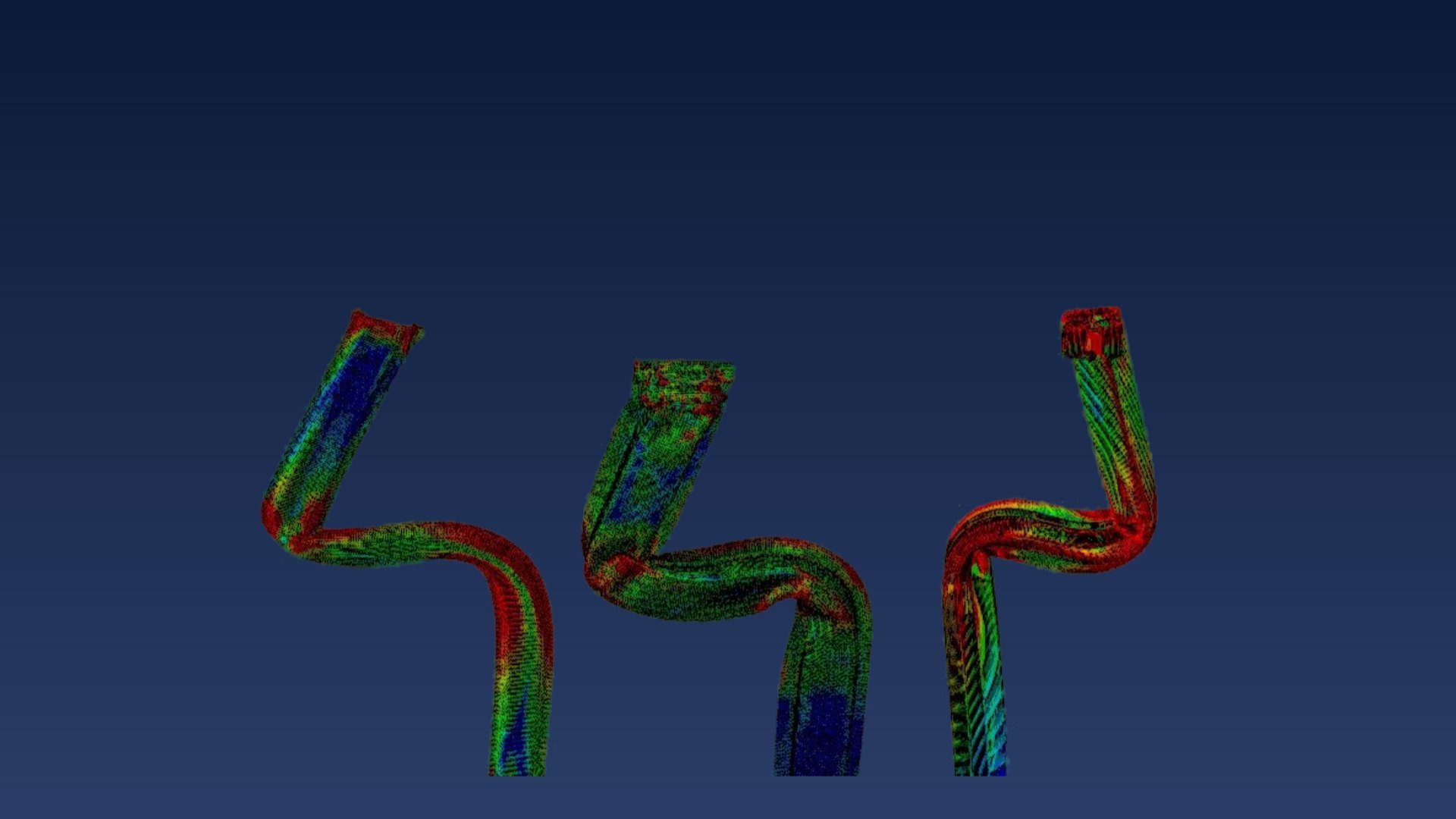
The three shapes at the end of the crush, von Mises stress.
- Impact speed
- 216 km/h
- Crush distance
- 300 mm
- Shapes tested
- 3
- Materials
- 5
Three shapes, one crash.
Three 1,000 mm tubes in AA6063-T5 aluminium, fixed at one end and hit at 60 m/s at the other. Only the cross-section changes: a diamond inspired by a front rail, a closed hat profile, and a square tube with internal walls.
Force during the crush
- Multi Cell TubeA 40 kN peak at the first fold, then a regular accordion collapse. Each inner wall adds corners, and the corners are what absorb the energy.
- Rail Crush3.2 kJ on paper, but almost a third is artificial (hourglass) energy from the C3D8R solid mesh. Less reliable result.
- Curved BeamThe beam buckles in global bending: the force drops close to zero and 1.7 kJ is still kinetic energy at the end of the crash.
Five materials on the Multi Cell.
The best shape was then tested with five alloys, under the same crash conditions. Titanium absorbs more than three times the energy of the reference aluminium.
Energy absorbed during the crash
With the same geometry, the part mass is proportional to the density. Index 1 = AA6063-T5 aluminium.
The right trade-off for a production car.
| Material | Energy | Peak force | Density | Energy / kg |
|---|---|---|---|---|
| Ti-6Al-4V | 12.4 kJ | 66 kN | 4.43 g/cm³ | ×2.1 |
| 304 steel | 7.4 kJ | 66 kN | 7.90 g/cm³ | ×0.7 |
| AA5052-H32 | 4.5 kJ | 58 kN | 2.68 g/cm³ | ×1.2 |
| AA6063-T5 | 3.7 kJ | 40 kN | 2.70 g/cm³ | ×1.0 |
| Mg AZ31B | 3.7 kJ | 37 kN | 1.77 g/cm³ | ×1.5 |
Titanium absorbs the most, but with a 66 kN peak that is hard on the occupants, and a cost far too high for a production car. Stainless steel absorbs twice as much as aluminium but weighs three times more: it loses as soon as you look per kilo.
- AA5052-H32+22% energy for the same mass as the reference alloy: the best trade-off for production cars.
- Magnesium AZ31BSame energy as aluminium, one third lighter: a real option for lightweight design.
- Titanium Ti-6Al-4VThe benchmark for pure performance, kept for motorsport and aerospace.
Team project (5 students), Computational Structural Mechanics module, ESILV 2025–2026. Models based on the Dassault Systèmes Crash workshops and Fang et al. (2015).